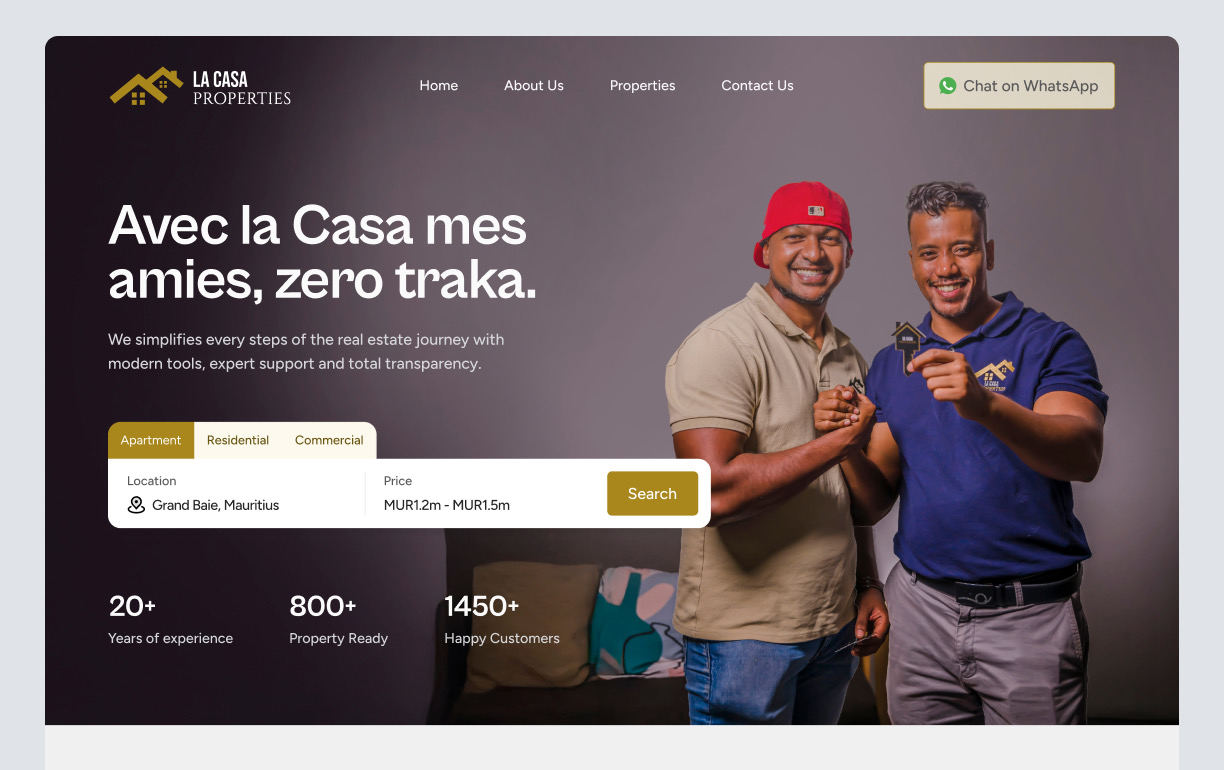
La Casa Properties Mauritius Website & Property Platform
Redefining real estate search with modern UX and intelligent automation
Tools used

Figma

Photoshop

Laravel PHP
Services
- UI/UX Design
- Front/back end development
- CRM Development
- Project Management
Client
La Casa Properties
Year
2026
Project background
La Casa Properties is a Mauritius-based real estate agency with a simple promise to its clients: Zero Traka. No hassle. For years, the team ran their entire operation out of a Facebook page. Listings were posted as social updates, inquiries came through comments and direct messages, and a growing catalog of homes across the island lived across hundreds of scattered posts.
It worked, until it didn't. As La Casa's inventory grew and their clientele expanded across the island's regions, the cracks in a social-only workflow started to show. Buyers couldn't filter. The team couldn't search their own listings. Leads fell through. The agency needed something that a Facebook feed could never be: a single, structured home for every property, every lead, and every conversation.
Vertex Experience partnered with La Casa to design and build that home: a fully custom website and property management platform that replaces social-media chaos with a clean, searchable, scalable system. This case study focuses on how we approached the problem, the solution we shipped, and, most importantly, the backend engine that powers it all.
Client’s feedback
Our platform was created with the support of the Vertex visionary team who helped shape the idea from concept to reality. Responsive, proactive, and deeply invested...
Ashley
Founder @ Hidden Mauritius
The Problem
Running a real estate business on Facebook is a short-term shortcut with long-term consequences. For La Casa, four problems had become impossible to ignore.
- Discovery was broken. A prospective buyer looking for a three-bedroom villa in Grand Baie under a certain budget had no way to find it. They had to scroll, guess, and hope the post they needed hadn't been buried by newer content. The catalog existed, but it wasn't browsable.
- Lead capture was informal. Inquiries arrived as comments, DMs, and phone calls. Unstructured, uncategorized, and easy to lose. There was no reliable way to know which buyer was looking for what, in which region, at what price point. Every conversation started from zero.
- Re-engagement was impossible.When a new property came onto the books, the team had no systematic way to reconnect with past buyers whose criteria matched. The match between supply and demand depended on someone remembering.
- Operations didn't scale. The team was small, the catalog was growing, and the cost of manual catalog upkeep (reposting, editing, archiving) was climbing fast. Every hour spent wrestling with Facebook was an hour not spent selling.
La Casa didn't just need a website. They needed a platform that would turn their business into a system.
Solution
We set out to replace a social-media workflow with a purpose-built product. The brief was simple to state and harder to execute: every property the agency represents should live in one place, every lead should be captured with structure, and every future listing should automatically find its way to the buyers already looking for it.
The outcome is a public-facing real estate platform with three surfaces working as one:
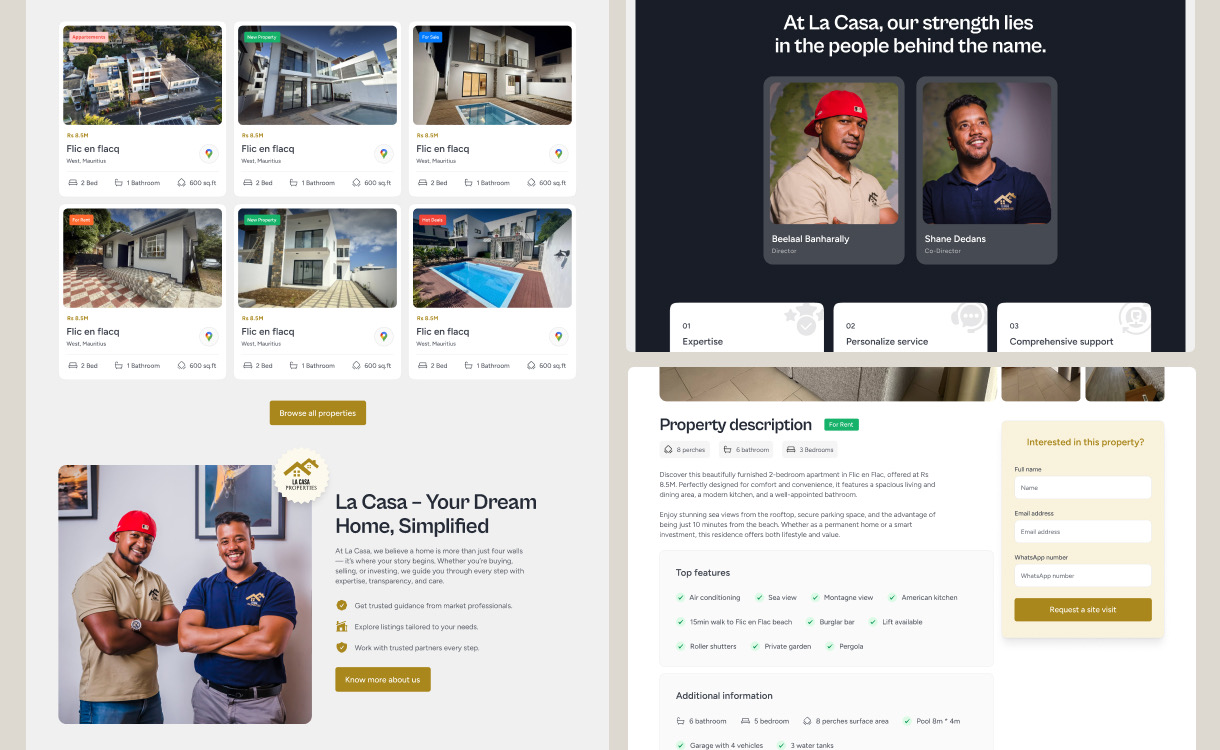
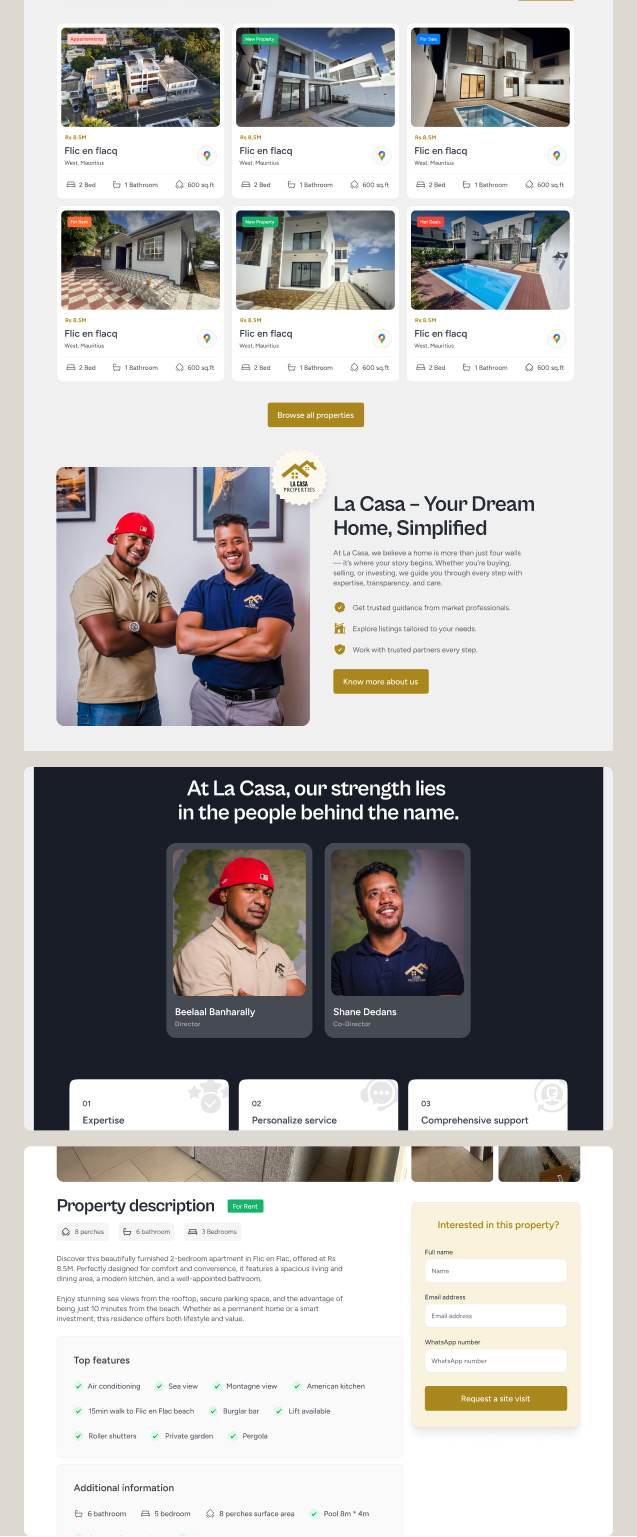
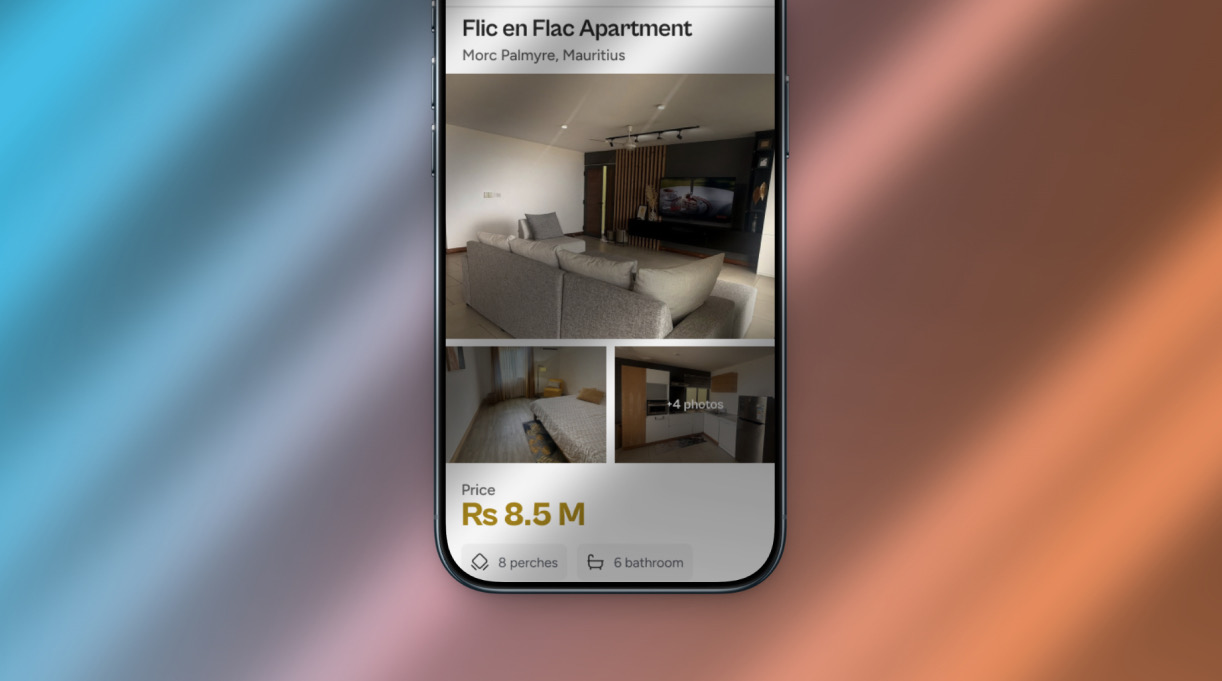
A discovery front-end that lets buyers filter by region, property type, price range, and features, with rich detail pages for every listing: photography, floor specs, location maps, video walkthroughs, and related attributes.
An intelligent CRM that doesn't just log leads but acts on them. When a buyer shares their preferences, the system remembers. The next time a matching property is published, the system automatically sends them a WhatsApp message, turning a passive lead list into an active match-making engine.
A full content management system that gives La Casa's team end-to-end control over every element of the public site: listings, FAQs, testimonials, partners, counters, SEO, and more, without ever touching a line of code.
The front-end is the face of the product. The backend is where it actually earns its keep. That's where we'll spend the rest of this case study.
Development: A Closer Look at the Backend
About 60% of the engineering effort on La Casa Properties went into the admin platform. The public website is the visible tip of the iceberg; the backend is the mass underneath it. Here's how it's built and why it matters.
A flexible property schema, not a fixed form
Real estate isn't uniform. A beachfront villa in Le Morne has very little in common with a studio apartment in Moka or a plot of land in Tamarin, and the fields a buyer cares about shift from one category to the next. Instead of hard-coding the property form, we built a schema that La Casa's team can reshape on their own.
Every listing is assembled from modular, admin-editable pieces. Categories (villa, apartment, land, commercial, and anything the team adds later). Features (pool, garden, parking, sea view, and the rest). Attributes, which are custom key-value pairs with their own icons, so the team can surface anything from "Year Built" to "Distance from Beach" on a listing without a developer in the loop. And Tags, each with custom background and text colors, so merchandising labels like "New Listing," "Hot Deal," or "Price Drop" can be created, styled, and applied in seconds.
The effect: La Casa owns their data model. When the market demands a new kind of attribute, they add it themselves.
🛠️ Kickoff & Audit
Week 1
- Understanding the core principles of the project
- Setting up Figma, Asana's workspace and relevant subs
- Discovery of usability gaps and inconsistencies in UX logic
🧠 Research & Strategy
Week 2 - 3
- Persona development
- Structuring of end-to-end user flows
- Defined goals for each user type
🧱 Wireframing & Testing
Week 4 - 5
- Created low-fidelity wireframes based on research
- Collaborative reviews and iterative refinements
- A/B testing to validate design decisions
🎨 Design Refinement
Week 6 - 7
- La Casa Properties branding across all screens
- Worked on the responsiveness of screens
- Finalized user flows and states
🚀 Client Reviews
Week 8 - 9
- Weekly calls for review & feedback
- Knowledge sharing with the client team
- Final delivery of redesigned files
💻 Development Starts
Week 10 - 15
- Developing and testing CRM components
- Responsive design implementation
- Weekly check-ins between design & dev teams for alignment
A dual-sided CRM
Most real estate CRMs do one thing: they log leads. We built this one to do two.
Inbound: Every property detail page carries a short, focused request form (name, contact, interest) which lands as a structured Property Request attached to the exact listing that triggered it. The team sees, for any given property, every person who raised a hand about it.
Outbound: The CRM also captures buyer preferences in a separate, dedicated flow. A prospective buyer tells the system what area of the island they're interested in, what price range they can work with, and what kind of property they're looking for. That profile sits in the CRM with a Notify toggle, a status workflow (New, Contacted, and onward), and a comments thread for the team to keep notes across conversations.
When a new property is published, the system checks every active buyer profile against the listing. Every matching buyer with Notify enabled gets a WhatsApp message, automatically, instantly, and with the property link built in. A lead that might have languished for weeks becomes a live conversation within minutes of a listing going up.
It's the single biggest behavioral change the platform introduces. The agency stops pushing listings into the void and starts routing them directly to the people already waiting for them.
Mauritius isn't a single market. It's several. Buyers in the North are not the same buyers as in the South, and the team's mental model of the island is regional first, specific second. The Locations module reflects that: every location is tagged to one of five regions (North, South, East, West, Centre), and the 40+ villages and towns the agency operates in, including Grand Baie, Moka, Tamarin, Flic en Flac, Belle Mare, and Le Morne, slot cleanly underneath.
Buyers filter by region or by specific location. The CRM captures preferences at either level. And the data model mirrors how the team actually talks about the country. An integrated CMS, not a bolted-on one
The team needed control over more than listings. So we built the rest of the site the same way: every public-facing surface is admin-editable.
Homepage counters (years in business, properties sold, happy clients) update without a redeploy. FAQs are managed through a structured editor. Partners and Testimonials are added and reordered on demand. Price Ranges feed the homepage search filter and can be tuned as the market shifts. SEO is handled page by page with support for dynamic tokens like {{category}}, so a single template populates a different, optimized meta title for every listing type. And a Contacts inbox collects general inquiries from the site's contact form, separately from property-specific requests.
When the market changes, the team changes the site. No tickets, no waiting.
Role-based team access
The platform is built for a team, not a single admin. User roles and permissions are first-class. Different team members can be given different levels of access to listings, leads, and content. The CRM lives alongside the catalog, which lives alongside the CMS, which lives alongside user management. One login, one product, one source of truth.

Design Principles
Running operations and UI/UX in parallel meant the design brief and the engineering brief never drifted apart. A few principles shaped the platform:
Status at a glance. The CRM, the property list, and the request queue all use color, tags, and state labels to make the next action obvious. The team should never have to read a screen to understand it.
Low-friction lead capture. Every request form on the public site asks only what's needed to move the conversation forward. Anything more is a drop-off.
Admin as a product. The backend isn't a back-office afterthought. It's designed with the same care as the public site. The team uses it every day; it had to feel like a tool, not a chore.
What's Next
The platform is live and the team is operating on it. The next chapter is about compounding the value that's already been built.The platform is live and the team is operating on it. The next chapter is about compounding the value that's already been built.
On the roadmap: saved searches and buyer accounts on the public side, so end users can log in and manage their own match preferences; analytics on the match-alert funnel, so La Casa can see exactly how many WhatsApp alerts convert into viewings and sales; in-platform tour scheduling, so a matched buyer can book a visit without leaving the thread; and market insights powered by the agency's own data (price trends by region, demand signals by category) turned back into decision support for the team.
La Casa started on Facebook. They don't need Facebook anymore.
Featured work
Some projects cannot be showcased due to agreement so if you want to see more, please get in touch with the team.
Click Here